Synthetic audiences: competitive landscape
Joint Claude/Codex research, reviewed 25 October 2026. Vendor descriptions reflect the cited primary pages. Performance figures are vendor claims, not results independently reproduced by Trueness. Brand interpretations and strategic implications are our analysis.
The commercial conclusion
Human-grounded synthetic audiences and human validation already exist. Electric Twin and Simile are especially close comparators; Fairgen now competes with an integrated consumer-data and audience platform. Trueness should not claim to have invented calibration or to be the first or only company connecting synthetic audiences with human research.
The proposed position is bespoke audiences with an inspectable calibration record, plus an audit service that can test audiences built elsewhere. Define the population, market, language and task; test a frozen configuration against fresh human evidence; record failures and uncertainty; and limit future use to what the evidence supports. This is a commercial hypothesis requiring buyer interviews and paid pilots, not a proven uncontested market gap.
Competitive set: proposition, route to market and brand
| Competitor | Proposition and distinctive capability | Observed go-to-market | Brand reading and implication for Trueness |
|---|---|---|---|
| Electric Twin | Builds audiences from customer survey data; describes withheld-answer validation and periodic revalidation with fresh human responses. | Enterprise demo and client-data engagements. | Evidence-led and research-oriented. Direct overlap with bespoke calibration; differentiation must extend beyond using real humans. Method |
| Simile | Human-grounded simulations; describes weekly human validation, distribution/effect-size evaluation and fresh data when drift is detected. | Enterprise sales, custom-data partnerships and demonstrations. | Scientific and ambitious. Ongoing validation is already part of a competitor's offer. Primary site |
| Aaru | Population-scale behaviour simulation and decision testing; publishes aggregate benchmark results on its own site. | Enterprise contact-led sales and customer evidence. | Institutional and predictive. Compete on inspectable task-level evidence, not simulation scale. Primary site |
| Evidenza | Synthetic research for difficult-to-recruit audiences, particularly B2B, connected to marketing decisions. | Demo-led enterprise selling, testimonials and business-outcome stories. | Consulting-oriented and commercially direct. Sell an answer to a business problem. Primary site |
| Fairgen | Connects research, customer data and market intelligence; turns respondent records into reusable audiences and links answers to sources. | Enterprise working sessions and demos, with integrations presented as part of the platform. | A consumer operating system, not merely a survey-boosting tool. Direct competition for the customer's research workspace. Primary site |
| Synthetic Users | Conversational synthetic participants for discovery; explicitly describes a supporting role alongside human research. | Demo-led access with published annual pricing and research-token pools. | Accessible product/research tool with stated limits. Transparent scope is not unique to Trueness. Pricing and scope |
| FishDog | Synthetic audience research through a platform licence; its own market map describes unlimited studies. | Content-led acquisition and platform sales. | Practical buyer education. Its market map is useful content written by an interested vendor. Vendor-authored map |
| Artificial Societies | Audience-network simulations for strategic communications, crisis planning and investor relations. | Demo-gated enterprise offer on the current site. | Communications and social influence. Network interaction differs from a bounded concept-test audience. Primary site |
| Yabble | Reusable AI personas combining model knowledge, trend/behavioural information and proprietary data; written and visual concept testing. | Demo-led sales, case studies and use-case content. | Fast, approachable insight generation. An alternative for buyers seeking immediate exploratory answers. Virtual Audiences |
| Qualtrics | Human and synthetic audience responses within an established research ecosystem; terms define a credit model. | Distribution through the existing platform/customer relationship. | Enterprise familiarity and procurement convenience. An additional purchase needs a clear benefit. Edge terms |
| Kantar LINK AI | Predicts advertising-test outcomes using historical human advertising research; describes held-out ad testing. | Specialist research product sold through enterprise relationships. | Established research authority. Category-specific prediction is not an unrestricted synthetic population. Method |
| Toluna | Synthetic Personas within a broader human-research and technology business. | Enterprise research relationships and product sales. | Human access plus research infrastructure. A competitor and possible fieldwork/channel counterpart, subject to agreement. Corporate products |
| Ipsos | Methods addressing synthetic uncertainty and human anchoring alongside its broader research offer. | Research relationships and methodological thought leadership. | Established methodological authority. Statistical caution already exists in the category. Calibrating Synthetic Confidence |
| Remesh | AI-assisted live and asynchronous conversations with actual people. | Demo-led platform and supported research services. | Rapid human understanding. A substitute for some synthetic use cases and possible human-research supplier, not a synthetic-only panel. Primary site |
Potential partnership is not an existing relationship. Vendor-neutral audit depends on lawful access to a reproducible audience or its frozen outputs; Trueness cannot promise to audit every closed platform.
The competitive set on two axes
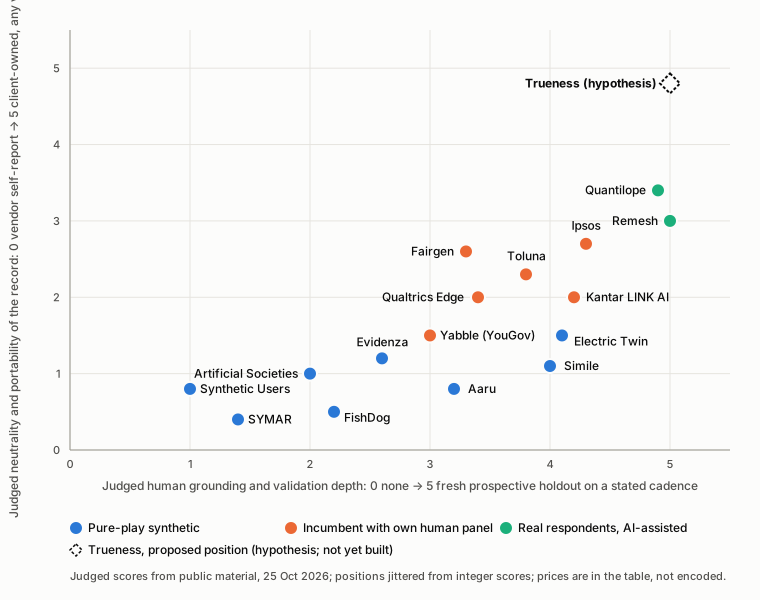
Figure: competitive-map.svg. Positions are judged scores from the public material reviewed on 25 October 2026, not vendor-supplied metrics. Horizontal: depth of human grounding and validation, from none (0) to a fresh human holdout every cycle (5). Vertical: neutrality and portability of the validation record, from vendor self-report (0) to a client-owned record that covers any vendor's audience (5). Marker size is the indicative annual spend tier; colour is the segment. Trueness is a proposed position, not a product. Hover or focus a mark for its scores.
| Vendor | Segment | Grounding (0–5) | Neutrality (0–5) | Spend tier | Why |
|---|---|---|---|---|---|
| Synthetic Users | Pure-play | 1 | 1 | Under $75k | No human validation offered; honest scope statement |
| SYMAR | Pure-play | 1 | 0 | Under $75k | Self-serve; grounding in uploaded data only |
| Artificial Societies | Pure-play | 2 | 1 | $75–250k | Public-data personas; self-reported distribution accuracy |
| FishDog | Pure-play | 2 | 1 | $75–250k | Census and attitudinal grounding; self-reported overlap with focus groups |
| Evidenza | Pure-play | 3 | 1 | $75–250k | Validations against partner surveys, metric undisclosed |
| Aaru | Pure-play | 3 | 1 | $250k+ | Outcome-grounded populations; self-reported error metrics; evaluation team hiring |
| Simile | Pure-play | 4 | 1 | $250k+ | Weekly real-human validation on its own site; drift-triggered fresh data |
| Electric Twin | Pure-play | 4 | 2 | $250k+ | Client survey seed data; hidden-split validation; periodic revalidation |
| Yabble (YouGov) | Incumbent | 3 | 2 | Under $75k | Inside a human panel owner's products |
| Qualtrics Edge | Incumbent | 3 | 2 | $250k+ | Synthetic tier of an enterprise survey platform |
| Toluna | Incumbent | 4 | 2 | $250k+ | Personas from its own 81m panel |
| Fairgen | Incumbent-adjacent | 3 | 3 | $75–250k | Boosts real surveys; one independent validation |
| Ipsos | Incumbent | 4 | 3 | $250k+ | Published calibration statistics paper; KnowledgePanel grounding |
| Kantar LINK AI | Incumbent | 5 | 2 | $250k+ | Hold-out validation on 10,000+ ads; inside its own product |
| Remesh | Real respondents | 5 | 3 | $75–250k | Every respondent is human; no synthetic to validate |
| Quantilope | Real respondents | 5 | 3 | $75–250k | Same |
| Trueness (hypothesis) | Calibration layer | 5 | 5 | $75k audit to $1m+ programme | Fresh human holdout each cycle; client-owned record; any vendor's audience |
Reading the map: the pure-plays climb the grounding axis but stay at the bottom of the neutrality axis because each validates its own product. The incumbents sit higher on both because they own human panels and sometimes publish method, but their records are not portable. The empty top-right is the position Trueness proposes to occupy. Every vendor on the map could move up the neutrality axis by offering to be audited; the first to do so with a client-owned record becomes the reference.
Interpreting validation claims
Correlation, agreement of conclusions, similarity of themes, mean absolute error, distributional distance and performance relative to human test–retest are different quantities. They cannot be placed in one accuracy league table.
For example, Evidenza's EY testimonial describes 95% agreement of conclusions. It does not report a 0.95 correlation or establish prospective accuracy for another customer, population or task. Evidenza
Electric Twin's withheld-data testing is substantive validation within its design; it should not be dismissed as an internal-consistency check. Trueness proposes freezing an audience before collecting a new human holdout and reserving new stimuli. This tests a defined kind of transfer while retaining sampling, coverage, weighting and task-generalisation limits. Electric Twin's method
Simile explicitly describes recurring human validation and drift response. The distinction must therefore be the exact service, customer access to evidence, independence arrangements and willingness to report an inconclusive result. Simile
Independent findings and their limits are documented in the evidence register. The calibration protocol translates them into a proposed pilot; published studies have not already validated Trueness.
Go-to-market patterns and recommended response
Enterprise selling is prominent among the closest comparators. Their current pages emphasise demos, customer relationships and tailored data. Our inference is that trust, access and procurement are material parts of the sale. This does not establish market-wide contract values or rule out self-service.
Incumbents have distribution and human-data advantages. A buyer's alternative may be an existing supplier's AI feature, a faster human study or an internal model workflow. A startup-only competitor set understates the competition.
Demonstrations make the product tangible. Show a consented comparison: decision brief, frozen prediction, human result, uncertainty and permitted use. Include failed or inconclusive endpoints rather than turning a selected success into a universal accuracy claim.
Start with a bounded service. Target agencies and brand/insights teams with an accessible consumer audience, usable source material and repeated concept/message-testing needs. Travel-sector experience may provide access; it does not establish transfer to other categories.
Offer Audit, Audience and optional Maintained services. Audit serves buyers who already have synthetic outputs; bespoke construction serves requirements poorly met by generic audiences. Maintenance must earn renewal through useful studies and valid evidence. Initial sales should be founder-led with automated qualification and proposal preparation, while a research lead decides whether the claim is testable.
Start with two paid builds and one paid audit, following readiness gates before the 90-day delivery period. Use the financial case for bottom-up volume and capacity assumptions rather than extrapolating the whole market-research industry into a synthetic-audience market size.
Proposed distinction and competitive limitations
| Proposed distinction | Required delivery | Limitation |
|---|---|---|
| Audit audiences built elsewhere | Lawful access, frozen outputs/configuration, agreed test and separately controlled holdout. | Closed platforms may prevent access; incumbents can replicate the service. |
| Portable customer evidence | Client-owned Calibration Record with scope, versions, metrics, uncertainty, failures, expiry and allowed uses. | Do not assert that competitors withhold equivalent records; compare actual contracts. |
| Fresh prospective comparison | New respondents and reserved stimuli after model/protocol freeze. | Additional cost and time; supports only tested populations and tasks. |
| Paid inconclusive outcomes | Contract pays for sound evaluation even when the audience fails. | Buyer acceptance requires pilot evidence. |
| Maintained scope and history | Drift checks, change control, expiry and separately scoped revalidation. | Routine pulses do not renew validity automatically; rivals already describe ongoing checks. |
| Low founder administration | Automated scheduling, evidence assembly, billing and monitoring with accountable human research decisions. | Human recruitment, review and exceptions remain real costs. |
For Trueness-built audiences, an external reviewer and separate holdout custodian reduce conflicts without making the builder wholly independent. Third-party audits must also disclose commercial relationships.
Defensibility would accumulate through consented benchmarks, reliable delivery, interoperable records and customer trust. The method and features are replicable. No leadership, exclusivity, regulatory endorsement or standards-body recognition has been established.
Brand opportunity and remaining checks
The proposed territory is faithfulness to the people being represented. Competitors often foreground speed, access, prediction and convenience; several also foreground evidence and honest limits. Trueness must demonstrate faithfulness through clear human-versus-synthetic labels, accessible methods, bounded promises and useful failure results. The written brand platform follows the reference brand-page structure and leaves visual identity undecided.
This is a dated primary-source scan, not a complete census or independent product benchmark. Public pages do not establish contract rights, retention, willingness to pay or unpublished validation quality. Unverified prices remain unknown in the pricing review.
Next: request comparable quotes and evidence packs; interview buyers about independence and payment for failure; obtain exact fieldwork quotes; and execute the paid pilot. Name availability and intellectual-property clearance remain separate launch work.